
Introduction
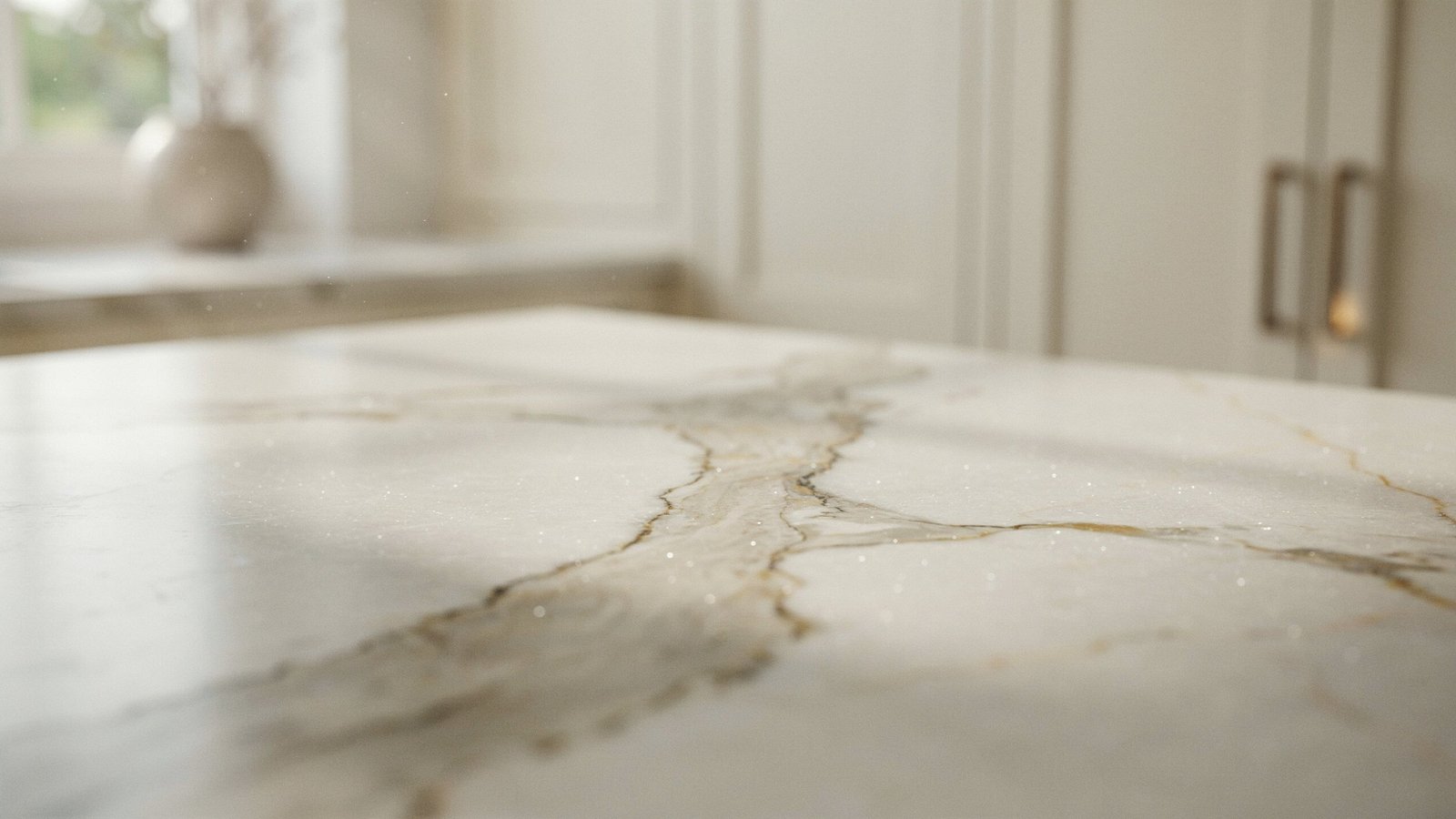
Ever seen a kitchen island with white-and-gold veining so dramatic it looks straight out of Tuscany, then found out it’s not marble at all? That’s usually Stone Concepts Misterio Calacatta quartz. This guide covers what it actually costs installed, how it holds up in a busy kitchen versus a bathroom vanity, and what daily cleaning really looks like once it’s in your home.
Table of Contents
Misterio Calacatta Quartz vs Marble and Other Quartz Brands: What’s the Difference?
Real Calacatta marble etches when acid touches it; Misterio Calacatta quartz doesn’t, because it’s a crushed quartz composite bound with resin instead of a natural, calcite-based stone. That single difference explains most of what separates the two materials in daily use.
Real Calacatta marble is quarried in Tuscany and made almost entirely of calcite, which is chemically reactive. Leave a splash of lemon juice, red wine, or even tomato sauce sitting on it for a few minutes, and you’ll see a dull spot where the acid has etched into the surface — a permanent change, not a stain you can wipe away. Stone Concepts’ version is built differently. It’s an engineered quartz composite, made from ground quartz particles — roughly 90 to 93% of the slab by weight — bound with a polymer resin binder under high pressure. That resin fills every natural gap in the material, which is why the finished slab is a genuinely non-porous quartz surface. Acids sit on top instead of soaking in, so the same wine spill that would ruin a marble counter just wipes away here.
This resistance matters just as much on a bathroom vanity as it does in a kitchen, where makeup, toothpaste, and skincare acids sit on the surface daily. If you’re still finalizing your vanity layout, it’s worth checking the standard bathroom vanity depth before choosing a slab size, since depth affects how much material — and how many seams — your project actually needs.
This is the core of any honest Calacatta vs quartz comparison: you’re not just choosing a colour; you’re choosing how the material behaves when your kitchen gets used the way kitchens actually get used. A busy household running acidic sauces, citrus, and wine glasses across the counter every week will see real wear on marble within a year or two. The same household won’t see that wear on quartz at all.
Misterio Calacatta doesn’t compete at the top or bottom of the quartz market — it sits squarely in the mid-tier range. Cambria, which manufactures domestically and backs its slabs with a lifetime warranty, typically runs $10 to $30 more per square foot installed — buyers are paying partly for that warranty and partly for brand recognition. MSI and Silestone fall into a similar price bracket as Stone Concepts, so pricing alone rarely settles the decision between them. What actually separates these brands is quartz pattern consistency — how uniform the veining looks slab after slab — and the intensity of the vein movement itself, whether it’s bold and dramatic or soft and understated. Misterio Calacatta leans into dramatic, sweeping gold veins rather than the tighter, softer movement you’d see in a Carrara-style quartz. If your kitchen calls for something quieter, Stone Concepts Skara quartz — the cooler-toned pattern in the same product line — is worth a look before you commit to the bolder Calacatta veining.
Where does this leave the marble-versus-quartz decision? If the luxury marble appearance is non-negotiable but you’re not willing to seal a countertop twice a year or babysit every spill, quartz gives you that same Calacatta marble look quartz buyers are searching for, minus the upkeep. If you’re weighing quartz against natural stone more broadly — including granite, which behaves very differently from marble under acid and heat — the granite countertops guide breaks down that comparison in more detail.
What Does Stone Concepts Misterio Calacatta Quartz Cost Installed?
Across most U.S. markets, Stone Concepts Misterio Calacatta quartz installs for roughly $55 to $100 per square foot — though where you land in that range depends on a few key factors. That’s a wide range, and the reason it swings so much comes down to a handful of predictable variables rather than random pricing.
Unlike natural stone, where the slab’s rarity drives price, an engineered quartz composite like this one costs more in fabrication and labor than in raw material. The polymer resin binder and ground quartz particles that make up the slab are manufactured to consistent standards, so the material cost stays fairly stable — what changes the final number is your local labor market, the edge profile you pick, how many cutouts your layout needs, and whether you’re adding something like a waterfall edge or a book-matched seam.
Vanity pricing shifts a little differently, since the layout usually plays a bigger role than the material itself. If you’re pairing this quartz with a darker cabinet base, browsing a few black vanity bathroom ideas before finalizing your design can help you plan cutouts and edge profiles around the final look, rather than adjusting the quote after the fact.
Here’s how a typical kitchen project breaks down by line item:
- Material cost to the fabricator: $25–$50 per sq ft, depending on slab lot and distributor markup
- Fabrication labor (cutting, edging, polishing): $15–$30 per sq ft
- Installation and haul-away: $10–$20 per sq ft
- Sink cutout: $100–$200 each
- Cooktop cutout: $75–$150 each
- Edge upgrades (ogee, waterfall): $15–$40 per linear foot extra
Here’s what that looks like in a real kitchen: a 40-square-foot space with one undermount sink cutout and a simple eased edge typically costs $2,200 to $4,000 installed. Push that up to a 60-square-foot kitchen with a waterfall island and upgraded edges, and the total can climb to $7,000–$10,000 without anything unusual happening — that’s just what a non-porous quartz surface with premium detailing costs to fabricate correctly.
Vanity projects work a little differently. Even though a bathroom vanity might only be 25 square feet, minimum shop charges of $500 to $800 often apply regardless of size, so the price per square foot doesn’t scale down the way people expect. A single-sink vanity with one cutout commonly runs $1,400 to $2,500 installed once you account for that minimum.
Before you reach out to fabricators for quotes, consider these points:
- Ask whether the quote is priced for 2 cm or 3 cm material — this single detail explains most low-ball estimates.
- Confirm whether cutouts and edge upgrades are itemized separately or bundled into the total.
- Get quotes from at least two or three fabricators using the same slab thickness and edge profile, so you’re comparing quartz vs natural stone or quartz vs granite on equal footing rather than guessing at what’s included.
If you’re still deciding between materials at this budget level, the kitchen countertops guide has current pricing across granite, marble, and laminate for a broader comparison before you commit to quartz.
Does Misterio Calacatta Quartz Work Well as a Kitchen Countertop?
Yes, Misterio Calacatta quartz holds up well as a kitchen countertop — it’s durable, stain-resistant, and low-maintenance — but it does come with one heat-related limit you need to respect.
As an engineered quartz composite, this material is built to handle what a working kitchen throws at it daily. The non-porous quartz surface resists spills, doesn’t stain from oils or sauces, and won’t harbor bacteria the way porous materials can, since there’s nowhere for moisture or food particles to sink in. For a household cooking dinner most nights, chopping vegetables, and dealing with the occasional wine spill on the island, that’s exactly the kind of low-fuss performance people search for when comparing a Calacatta marble look quartz option against real marble.
Durability in Daily Use
The quartz aggregate composition — ground quartz bound with pigment and resin — gives the surface strong scratch resistance, scoring around 7 on the Mohs hardness scale. That’s harder than most kitchen knives, so normal use won’t leave marks, though a cutting board is still the smarter habit for protecting the finish long-term rather than the material itself.
The Heat Caveat You Shouldn’t Ignore
Here’s the one real trade-off. The polymer resin binder that makes this surface non-porous and easy to clean is also its weak point when it comes to heat. Sustained or sudden heat above roughly 300°F can discolor or even crack the resin, and it’s a common mistake: someone pulls a cast-iron skillet straight off the stove and sets it down on the counter without thinking. This kind of heat damage is usually permanent, and most quartz warranties won’t cover it. The fix is simple: using a trivet or hot pad every time, which is a habit shift, not a flaw in the material itself.
Real-World Fit for Busy Kitchens
Beyond the heat rule, this pattern earns its keep in kitchens that see real daily use. A few practical advantages worth knowing:
- The bold gold veining hides minor smudges and fingerprints between cleanings, which matters more than people expect in a high-traffic kitchen
- 3 cm is the standard thickness for kitchen tops, spanning cabinet runs without needing extra substrate support
- The consistent quartz pattern consistency across the slab makes it easier to plan seams around an island without visible mismatches
For anyone weighing this against other surfaces before finalizing a kitchen plan, the broader quartz vs natural stone debate — including how granite and quartzite perform under heat and daily wear — is also worth exploring before you commit to a final material.
Is Stone Concepts Misterio Calacatta Quartz Good for a Bathroom Vanity?
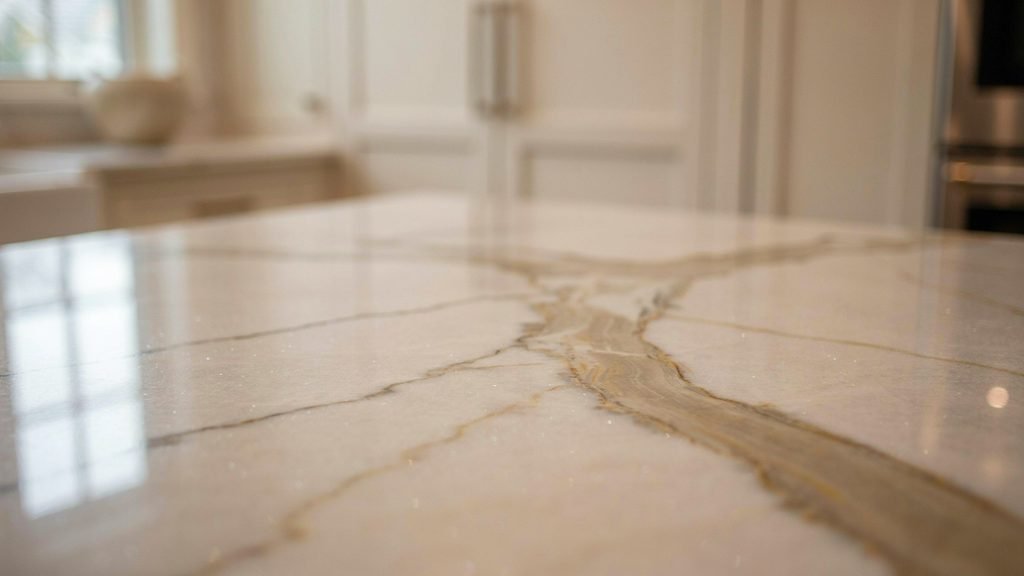
Yes — a bathroom vanity is actually one of the strongest applications for Stone Concepts Misterio Calacatta quartz, thanks to how well it handles constant moisture without absorbing anything into the surface.
Because it’s a non-porous quartz surface, this material doesn’t soak up water, soap residue, or the daily mix of makeup and skincare products that end up on a vanity top. That matters more than people realize. Marble vanities, for comparison, can pull pigment from foundation or lipstick and dull over time from contact with glycolic acid or vitamin C serums — two ingredients sitting in most bathroom cabinets right now. Quartz simply doesn’t have that vulnerability, since the polymer resin binder seals off every natural gap in the quartz aggregate composition before it ever leaves the fabrication shop.
This consistency also makes it easier to plan a shared bathroom layout, especially if you’re working with a his-and-hers setup. For homes designing around two separate vanities kitty corner, matching the same low-maintenance quartz across both counters keeps the look and the upkeep identical on either side of the room.
Thickness for Vanity Applications
Vanities don’t need the same structural thickness as a kitchen countertop, since the load and span are both smaller. A few points worth knowing:
- 2 cm thickness works as the go-to standard for vanity countertops, staying structurally sound as long as the cabinet provides full support underneath
- Lighter 2 cm material is a practical choice for floating vanity designs, where weight becomes a real factor
- Fabricators can add a laminated edge strip to 2 cm quartz, giving it the visual weight of a thicker slab without the cost of a full 3 cm cut
The Seam and Silicone Detail Most People Skip
Here’s a real-world scenario worth flagging: a vanity backsplash sits inches from a faucet that sprays water dozens of times a day. If the seam between the countertop and the backsplash piece isn’t siliconed correctly, water works its way into the cabinet below over months, causing swelling or mold long before anyone notices a problem on the surface. This is a fabrication detail, not a material flaw — the Calacatta marble look quartz finish itself handles moisture fine, but the joint where two pieces meet is only as good as the installer’s silicone work.
It’s worth asking your fabricator directly how they seal that seam, and confirming it’s checked again a few weeks after installation once the silicone has fully cured. For anyone weighing this same quartz vs natural stone decision for a full bathroom remodel rather than just the vanity, the broader maintenance routine for stone and quartz surfaces follows similar daily-care logic across both spaces.
How Do You Clean and Maintain Misterio Calacatta Quartz Countertops?
No sealing, ever — that’s the short answer, and it’s the biggest maintenance advantage Misterio Calacatta quartz has over natural stone.
Since this is a non-porous quartz surface, there’s nothing beneath it for a sealer to soak into. Daily cleaning stays simple — warm water with a little dish soap on a soft cloth handles most spills. High-pigment culprits like red wine or turmeric should still be wiped up quickly, since dried residue can bond to the polymer resin binder and take extra effort to remove.
A few things to avoid:
- Steel wool or abrasive scouring pads, which scratch the finish rather than the quartz itself
- High-concentration bleach, oven cleaners, and drain cleaners
- Acetone-based nail polish remover, a common cause of resin damage near vanities
Standard countertop sprays and diluted isopropyl alcohol are both safe choices. It’s also worth noting that prolonged UV exposure near a sunny window can cause slight yellowing over time, an industry-wide trait of resin-based quartz vs natural stone surfaces rather than a defect specific to this brand.
What Thickness Should You Order for Misterio Calacatta Quartz?
Two thicknesses cover almost every job: 2 cm and 3 cm. Which one you need really just comes down to whether you’re topping a kitchen or a vanity.
For kitchens, go with 3 cm. It’s the standard for a reason — it spans a normal 24-inch cabinet run without any flex or extra support underneath, and it just looks right against most cabinet heights. Most fabricators will quote kitchen jobs in 3 cm by default, so if you get a bid that comes in noticeably lower than the others, ask straight up whether it’s actually 2 cm material. That’s typically the reason behind the lower quote.
Vanities are a different story. 2 cm works fine here because the cabinet underneath is already doing the structural work. It’s also lighter, which matters if you’re going with a floating vanity design. Say you want the look of a chunkier 3 cm edge without paying for a full 3 cm slab — a laminated edge strip solves that, and it’s a trick a lot of fabricators use on bathroom remodels without anyone noticing the difference.
One more thing worth planning for: if you’re doing a waterfall island or want the veining to run continuously across a seam, budget extra regardless of which thickness you choose. That kind of layout eats more slab material and needs tighter fabrication work, so it’s not unusual to see an add of $1,500 to $3,000 on top of the base quote. Worth asking about early, before you fall in love with a specific layout your fabricator hasn’t priced yet.
How Does Misterio Calacatta Compare to Stone Concepts Skara Quartz?
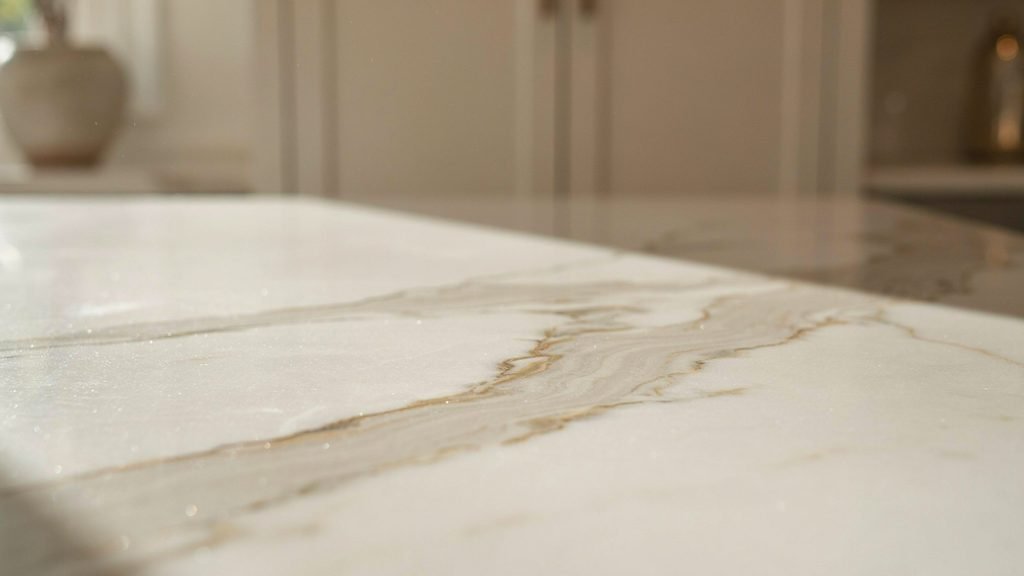
The difference between these two comes down to tone, not performance — Misterio Calacatta runs warm with gold veining, while Stone Concepts Skara quartz reads cooler with gray and silver movement. Once you know that, the choice mostly picks itself based on the rest of your room.
Where the Two Patterns Split
Misterio Calacatta has a warm white base with bold gold and taupe veins sweeping across it — the classic Calacatta marble look quartz buyers picture when they search for this style. Skara sits on a lighter, more neutral ground with gray or silver veining that feels quieter and more contemporary. Both come from the same engineered quartz composite line, so you’re not trading away durability or ease of care by picking one over the other. Same non-porous quartz surface, same resistance to stains, same zero-sealing maintenance.
Matching the Pattern to Your Space
This is the real deciding factor between the two. A kitchen with cream cabinets, brass hardware, and warm wood floors pulls naturally toward Misterio Calacatta — the gold veining picks up those warm tones instead of fighting them. A kitchen or bathroom built around gray shaker cabinets, matte black or brushed nickel fixtures, and cool-toned tile leans the other way, toward Skara.
A practical example: if you’ve already picked out light gray subway tile for a bathroom backsplash, Misterio Calacatta’s gold veining can clash more than you’d expect once it’s installed under real bathroom lighting, even if it looked fine on a small sample in the showroom.
One Step Before You Decide
Ask your fabricator for a larger remnant of both — at least 12×24 inches — and bring them home. Lighting shifts a lot between morning and evening, and a Calacatta vs quartz comparison made under showroom lights doesn’t always hold up once the slab is sitting under your own kitchen or vanity lighting.
Final Thoughts
Choosing Misterio Calacatta quartz really comes down to one trade-off: you get the marble look without the babysitting, as long as you respect the heat limit. That’s a fair deal for most kitchens and vanities built around daily, real life use. If you’re finalizing the vanity portion of your project, it’s worth reviewing bathroom vanity backsplash options before ordering your slab, since backsplash height and seam placement are easier to plan upfront than to adjust later. Before you sign off on a slab, sit with a real sample under your own lighting. Does it still feel right once the showroom shine wears off?
Frequently Asked Questions
How much does Vicostone Misterio cost?
Vicostone Misterio quartz typically runs $49 to $99 per square foot installed, similar to the Stone Concepts Misterio Calacatta price range, though exact cost depends on edge profile and cutouts.
Is Calacatta quartz high quality?
Yes. Engineered Calacatta-style quartz uses 90-93% crushed quartz bound with polymer resin, giving it strong scratch resistance and a non-porous, stain-resistant surface that holds up well in daily kitchen and vanity use.
What color is Misterio quartz?
Misterio quartz has a warm white background with bold brown, gray, or gold veining running across the slab, designed to mimic the look of natural Calacatta marble.
Is Calacatta more expensive than quartz?
Yes. Real Calacatta marble typically costs $90 to $200 per square foot installed, while Calacatta-look quartz like Misterio runs $55 to $100 — quartz gives a similar look at a lower price with less maintenance.
Is Calacatta quartz still in style?
Yes. White-and-gold Calacatta-pattern quartz remains one of the most requested kitchen and bathroom countertop styles, especially with cream cabinetry and warm-toned fixtures.
Should you use Clorox wipes on quartz?
Using it occasionally is fine, but high-concentration bleach can dull the polymer resin binder over time. For everyday cleaning, warm water with mild dish soap remains the safer choice.
Is Dawn dish soap safe on quartz?
Yes. Dawn and similar mild dish soaps are safe for daily quartz cleaning and won’t damage the non-porous resin surface.
What can ruin a quartz countertop?
Direct heat from hot pans, acetone-based nail polish remover, and abrasive scouring pads are the most common causes of permanent damage to quartz countertops.
About the Author
Bilal Khan
Content Writer & Home Improvement Researcher
Bilal Khan is an informational content writer specializing in home improvement and interior design topics, including countertops, kitchen renovations, and bathroom vanity solutions. He focuses on researching current pricing, material comparisons, and practical maintenance guidance to help homeowners make informed decisions before starting a renovation project. Bilal is passionate about breaking down technical stone and surface material details into clear, easy-to-understand guides for everyday readers.
Pingback: Antique Style Bathroom Vanity: A Simple Buying Guide
Pingback: Common Vanity Sizes: Complete Bathroom Dimension Guide
Pingback: Cost to Install Bathroom Vanity: Complete Guide