
Introduction
Have you ever stepped outside after applying makeup or shaving, only to realize your bathroom mirror completely lied to you? Figuring out how many lumens for bathroom vanity task areas are necessary is the key to getting clear, shadow-free lighting every morning. In this guide, we will break down exact lumen requirements by room size, mirror layout, color temperature, and fixture placement to help you create the perfectly lit space.
Table of Contents
Understanding Lumens: The Core Metric for Bathroom Vanity Brightness
Lumens measure the actual brightness visible to the human eye, whereas watts simply record how much electrical energy a bulb consumes. When planning your grooming space, focus on how many lumens for bathroom vanity setups require guarantees clear, accurate visibility without relying on outdated energy measurements.
Wattage vs. Lumens in Modern LED Fixtures
For decades, homeowners relied on wattage as a rough gauge for light output. A standard 60-watt incandescent bulb was long considered the benchmark for mirror lighting. Modern energy-efficient choices have completely changed those calculations:
- Traditional Incandescents: Pull 60 watts of electricity to produce roughly 800 lumens of light.
- Modern LED Vanity Bulbs: Generate that same 800-lumen output using just 8 to 10 watts of power.
- Key Takeaway: Comparing wattage versus lumen output reveals that higher energy consumption no longer equals a brighter space.
Understanding this core distinction helps you select fixtures based on actual brightness rather than energy draw, preventing common lighting mistakes that leave your room uncomfortably dim or harsh on the eyes.
Balancing Layered Illumination Zones
Determining the right light output for your mirror counter helps build a well-balanced layout between ambient and focused task zones. Layering overall ceiling fixtures alongside dedicated mirror sconces creates a versatile, comfortable environment for any time of day. For broader home improvement projects and smart fixture upgrades, exploring bathroom lighting design ideas can help you select and position fixtures to customize your overall lighting controls effortlessly.
Why Proper Lumens Matter Specifically for Your Bathroom Vanity Area
Proper vanity lumens ensure your face receives balanced, clear illumination so you can perform detailed personal care tasks without struggling against dark spots or harsh glares. Getting the right light output directly impacts how accurately you see skin tones, apply cosmetics, or trim facial hair each morning.
When setting up your mirror space, understanding how many lumens for bathroom vanity task areas are needed prevents common daily frustrations. For instance, trying to blend foundation or get a clean shave under a weak 400-lumen fixture often causes uneven makeup application or missed spots that only become noticeable once you step outside into natural daylight.
Insufficient or poorly targeted light output for bathroom mirror tasks forces your eyes to strain and creates dark patches across your features. Achieving the ideal bathroom vanity lighting brightness solves several everyday functional challenges:
- Eliminating facial shadows: Balanced vanity light fixture lumens cast light evenly across your forehead, cheeks, and chin, preventing dark shadows under your eyes and nose.
- Improving detail accuracy: Proper task lighting provides the clarity needed for close-up tasks like tweezing eyebrows or inserting contact lenses safely.
- Reducing eye fatigue: Correct brightness levels prevent you from squinting into the mirror, making your morning routine much more comfortable.
Meeting your specific mirror task lighting requirements transforms a basic washroom into a practical, high-functioning space. If you are also upgrading your fixtures or decor, exploring modern bathroom vanity styling guides can help you choose complementary frame styles and mounting depths that further enhance how light reflects around your mirror area.
How Many Lumens Do You Need for a Bathroom Vanity? (Quick Breakdown)
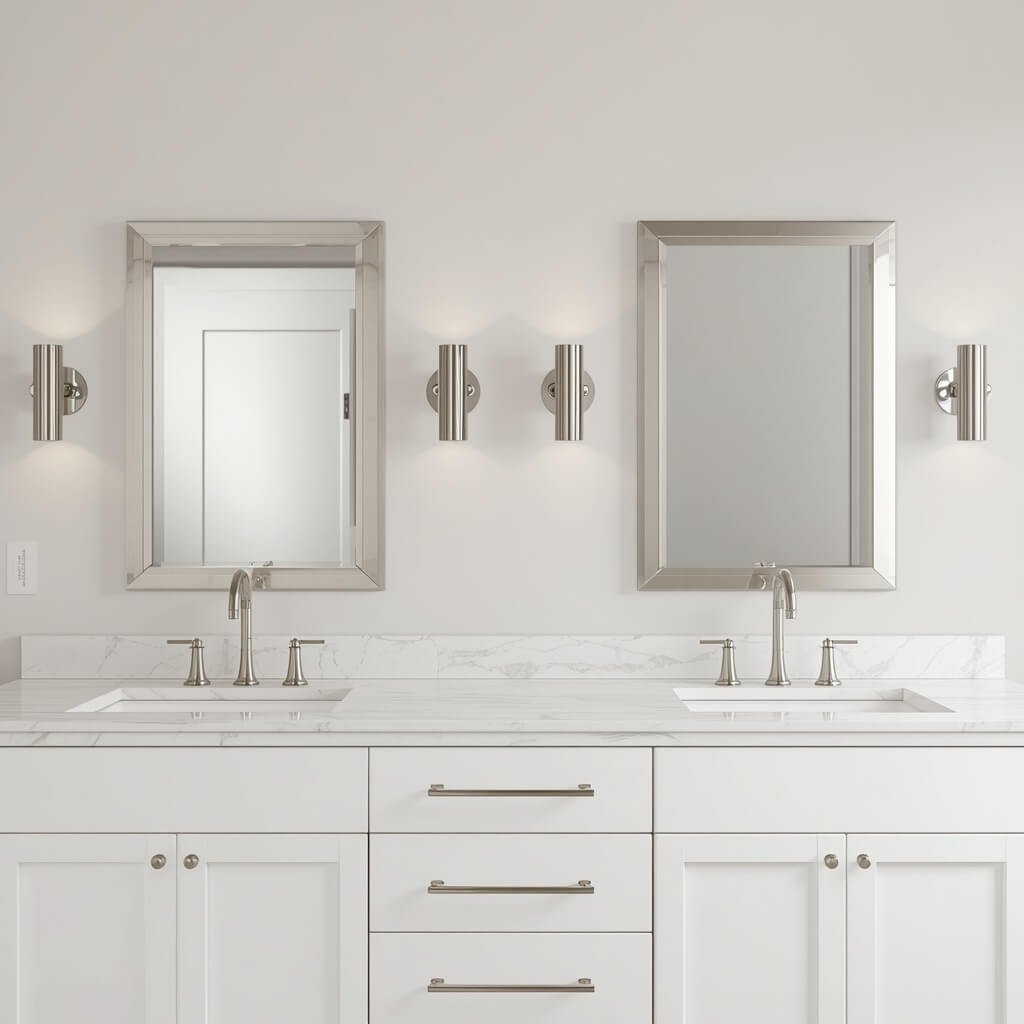
A standard bathroom vanity setup requires between 1,600 and 4,000 lumens in total to provide clear, shadow-free illumination for your daily grooming routine. Determining exact target ranges depends primarily on whether you are lighting a compact single-sink vanity or a spacious double-sink configuration.
Single Vanity Lumen Requirements
For a single vanity (typically 24 to 36 inches wide), a total target of 1,600 to 2,400 lumens works best. This is easily achieved by placing two side sconces providing 800 to 1,200 lumens each on either side of the mirror. In a small US powder room, installing a single overhead bar rated at 1,800 lumens delivers plenty of power to illuminate the sink area without overwhelming the compact room.
Double Vanity Lumen Requirements
Larger double vanities (60 inches or wider) require a higher total output, generally ranging between 3,200 and 4,000 double vanity lumens. Because two people may use the space simultaneously, spreading the light source evenly across the entire counter is essential.
- Three-Sconce Setup: Placing three wall sconces (left, middle, right) at 1,000 to 1,200 lumens each delivers balanced, continuous coverage.
- Dual Light Bars: Installing two separate 1,600 to 2,000 lumen fixtures—one over each mirror—ensures both grooming stations get direct, dedicated brightness.
Matching total output to your counter length prevents dim gaps in the center while maintaining proper ambient vs task lighting zones throughout the entire room.
Calculating Your Vanity Lighting Needs by Room Size and Square Footage
To calculate the exact total brightness your bathroom needs, multiply the room’s total square footage by the recommended foot-candles for each specific lighting zone. This math-based approach ensures you buy fixtures with the correct total capacity without under-lighting or over-lighting your space.
A foot-candle measures how much light reaches a specific surface one foot away from the source. While general bathroom space requires around 30 to 40 foot-candles for safe movement, grooming mirror task lighting requirements demand a higher concentration of 70 to 80 foot-candles. If you are upgrading your setup to accommodate multi-bulb fixtures or modern dimmers, checking out helpful bathroom vanity installation tips can help you plan fixture placement and wiring requirements smoothly before mounting your new lights.
You can determine your total lighting target using a simple square footage calculation (length x width):
- Measure Room Dimensions: A standard US bathroom measuring 8 feet long by 6 feet wide gives you a total size of 48 square feet (8 x 6 = 48).
- Apply Foot-Candles for General Space: Multiply 48 sq. ft. by 30 foot-candles to get 1,440 lumens needed for ambient general space.
- Calculate Vanity Zone Specifics: For a dedicated 10-square-foot vanity counter zone, multiply 10 sq. ft. by 75 foot-candles to get 750 target lumens focused directly on that grooming area.
Combining these calculations gives you a total target of roughly 2,200 lumens for the entire room. Allocating those lumens between overhead fixtures and wall sconces maintains balanced foot-candles for bathroom lighting without creating glaring hot spots over your sink.
Vanity Light Lumens Required Based on Mirror Size and Layout
Your mirror size and counter layout directly dictate how many vanity light fixture lumens you need to distribute light evenly across your entire face. Matching fixture output to physical proportions prevents dark corners around wide glass panels and eliminates harsh glare over smaller setups.
Selecting the right light output for bathroom mirror configurations depends on these specific mirror sizes and layouts:
- Small Mirrors (Under 30 inches wide): A compact single mirror in a powder room requires 1,200 to 1,600 lumens. Installing a two-light overhead fixture using LED bulbs for bathroom vanity setups easily covers this space without overwhelming small reflective surfaces.
- Medium Mirrors (30 to 48 inches wide): A standard residential vanity mirror needs 1,800 to 2,800 lumens. Mounting two vertical sconces at 1,000 to 1,400 lumens each alongside the glass provides optimal side illumination for close-up grooming.
- Large or Frameless Mirrors (48 to 60 inches wide): Wide single mirrors require 3,000 to 3,600 lumens. Using a four-bulb bath bar mounted above the glass ensures full edge-to-edge coverage across the extended surface.
- Double Mirror Layouts (60+ inches wide): Dual mirror setups require 3,200 to 4,000 double vanity lumens total. Splitting output between two dedicated light bars delivers focused illumination directly above each individual basin.
Proportioning your total brightness to your mirror area guarantees clear visibility across all active grooming zones.
Essential Factors That Impact Your Overall Bathroom Lumen Requirements
Several room features and personal needs shift your total target output away from standard baseline estimates. Wall paint finishes, ceiling height, daylight exposure, and individual sight needs directly influence how light bounces around your grooming area.
Interior Surfaces and Ceiling Dimensions
The finishes you choose for your walls and floors play a major role in how light reflects across your room. Glossy white surfaces naturally bounce light around, whereas dark paint tones and textured tiles actively soak up brightness.
- Wall Colors and Tile Finishes: If your space features deep navy paint or matte charcoal tiles, you should increase your overall bathroom vanity lighting brightness by 10% to 20% to achieve the same visibility as a bright white room.
- Ceiling Height Impact: Taller ceilings spread light over a wider space. A room with 10-foot ceilings requires higher fixture output to make up for the extra vertical distance down to your mirror and sink counter.
Natural Light and Personal Vision Needs
Daylight levels and personal sight needs also change your overall fixture choices. Windows offer plenty of ambient brightness during daytime hours, but your artificial lighting must still deliver full power once the sun goes down.
Additionally, optical needs naturally evolve over time. A 60-year-old homeowner generally requires nearly double the illumination level of a 20-year-old to carry out detailed mirror tasks with ease. If you want to customize your home environment further for comfort and accessibility, reading about smart bathroom vanity mirror setups can help you pair ambient features with variable vanity lighting for maximum daily convenience. Accounting for these variables ensures your selected LED vanity light output maintains a comfortable, highly functional space year-round.
Choosing the Right Color Temperature (Kelvin) and CRI for Vanity Bulbs
For true-to-life color accuracy and flattering illumination, bathroom vanity lighting requires a neutral white color temperature between 3500K and 4000K alongside a high Color Rendering Index (CRI) rating of 90 or above. Selecting these specifications ensures that your skin tone, clothing colors, and makeup appear exactly as they will in natural daylight. Warm 2700K bulbs create a yellowish tint that skews color perception, while cool bulbs above 5000K produce a harsh, sterile glare. Choosing LED bulbs for bathroom vanity setups within the 3500K to 4000K range on the Kelvin color scale provides crisp clarity without washed-out skin tones.
Along with color temperature, paying close attention to the color rendering index (CRI 90+) is vital for satisfying your mirror task lighting requirements. Standard low-CRI bulbs often make skin look unnaturally dull or pale, causing people to apply makeup unevenly or pick the wrong cosmetic shades. High-CRI LED fixtures accurately reveal true pigments just like natural sunlight, ensuring your morning routine is both smooth and reliable.
Strategic Fixture Placement to Maximize Light and Avoid Harsh Shadows
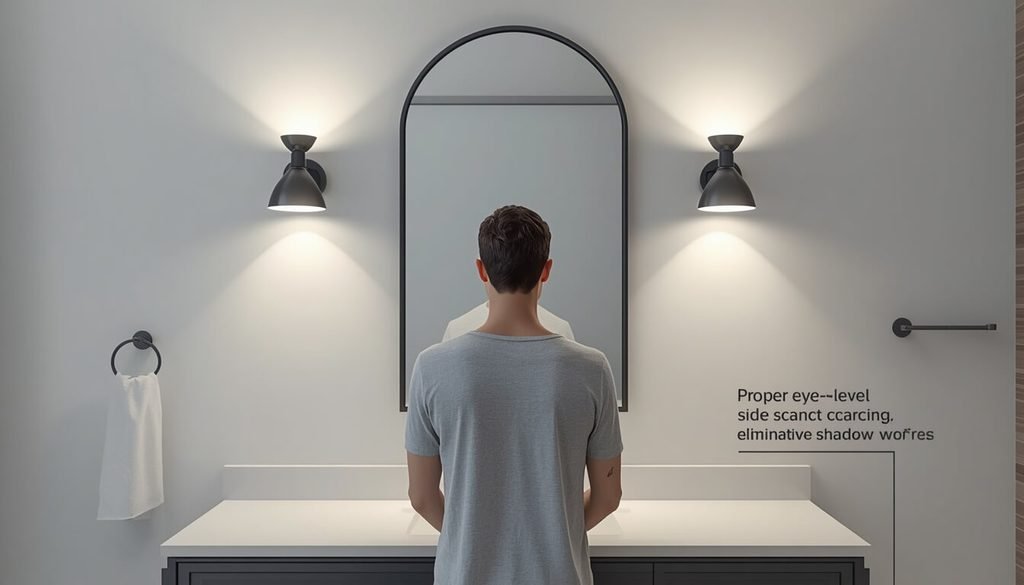
Mounting your fixtures at eye level on either side of the glass is the most effective way to eliminate facial shadows and maximize your mirror’s overall light output. Proper fixture placement guarantees that your total vanity light fixture lumens cast illumination evenly across your features without creating dark pockets under your eyes, nose, or chin.
Side Sconces for Eye-Level Illumination
Installing wall sconces on both sides of the mirror provides the ideal setup for daily grooming and makeup tasks. For the best performance, mount side sconces roughly 60 to 65 inches off the floor, keeping them centered at human eye level and spaced about 28 to 36 inches apart. Positioning your fixtures this way delivers balanced side illumination that meets all mirror task lighting requirements while eliminating facial shadows completely.
Overhead Lighting Placement
When space limits prevent side-mounted sconces, an overhead light bar placed directly above the mirror offers a reliable alternative. Mount overhead fixtures 75 to 80 inches above the finished floor, ensuring the light output for bathroom mirror surfaces washes down evenly. Pairing an overhead bar with recessed ceiling fixtures helps maintain distinct ambient vs task lighting zones, giving your bathroom a well-balanced layer of overall brightness. If you are planning a complete makeover for your grooming space, checking out modern bathroom vanity placement guides can help you align your mirror height, cabinet dimensions, and overhead fixtures perfectly.
Knowing how many lumens for bathroom vanity setups to buy is only half the equation; placing those light sources at the correct height and distance ensures you get maximum clarity without harsh glares.
Common Vanity Lighting Mistakes That Ruin Your Bathroom Illumination
The most common vanity lighting mistakes stem from relying on a single top-down light source and skipping dimmer switches, both of which cause awkward shadows and uncomfortable eye strain. Avoiding these setup errors ensures your bathroom vanity lighting brightness stays clear, functional, and flattering throughout the day.
Even when you buy fixtures with high LED vanity light output, poor installation choices quickly ruin your room’s usability. Homeowners frequently make these four critical mistakes during installation:
- Relying Solely on a Single Overhead Fixture: Placing just one light bar directly over the mirror casts harsh downward beams. This design mistake causes deep shadows under your eyes, cheeks, and nose, making detailed grooming much harder.
- Skipping Dimmer Control Switches: Non-dimmable fixtures keep you trapped with maximum brightness during midnight visits or relaxing evening baths. Wiring compatible LED dimmers allows you to seamlessly transition your space from bright, focused task illumination down to a gentle, calming glow.
- Ignoring Moisture and Safety Damp Ratings: Installing standard dry-rated fixtures too close to sinks or showers leads to internal corrosion and premature electrical failures. For safe residential wiring and moisture resistance standards, referencing safety guidelines from the National Electrical Contractors Association ensures your fixtures strictly meet local damp-location code requirements.
- Mismatching Bulb Color Temperatures: Combining a warm 2700K bulb in an overhead light with a cool 5000K bulb in a side sconce creates uneven color tones across your face, throwing off cosmetic accuracy.
Avoiding these simple setup errors keeps your foot-candles for bathroom lighting balanced while maximizing the performance and longevity of your fixtures.
Conclusion
Getting your vanity lighting right comes down to balancing total lumen output, placement, and color temperature. By matching your fixtures to your specific mirror layout and room size, you create a functional space that makes daily routines effortless. Take a moment to evaluate your current setup—does your mirror lighting truly serve your daily needs, or is it time for an upgrade?
FAQs
Is 1000 lumens enough for a small bathroom?
Yes, 1,000 lumens is generally enough for general ambient lighting in a small powder room (around 20 to 30 square feet). However, for detailed mirror tasks like shaving or makeup, you may want an extra focused light source at the vanity to reach around 1,500 total lumens.
Is 2000 lumens too bright for a bathroom?
No, 2,000 lumens is not too bright. It is actually the ideal sweet spot for an average-sized residential bathroom (around 40 to 60 square feet), providing crisp, comfortable illumination when split between overhead ceiling lights and vanity fixtures.
Is 1500 lumens too bright for a bathroom?
No, 1,500 lumens is a standard output that works exceptionally well for small to medium bathrooms. It offers plenty of clear visibility for daily grooming without causing harsh glare or over-illuminating the space.
Is 3000 lumens bright enough for a bathroom?
Yes, 3,000 lumens is more than bright enough for a medium to large bathroom (60 to 100+ square feet) or double vanity setups. Distributing this light across multiple fixtures ensures full coverage with no dark shadows.
Is 3000 lumens overkill?
It depends on the room size. For a tiny powder room, 3,000 lumens from a single fixture can feel glaring and overwhelming. However, for a master bathroom or double vanity counter, 3,000 total lumens spread across dimmable fixtures is completely normal.
Is 6000 lumens too bright?
Yes, 6,000 lumens from a single light source is far too bright for any standard residential bathroom. That level of output works best when divided into multiple layered zones across an exceptionally large luxury bathroom suite.
Is 10,000 lumens too bright?
Yes, 10,000 lumens is extreme overkill for any home bathroom. That level of brightness creates intense glare and eye strain, making it better suited for commercial garages, outdoor floodlights, or large open spaces.
About the Author — Bilal Khan
Bilal Khan is a content writer with an interest in bathroom design, vanity lighting, and practical home improvement ideas. He focuses on researching useful information and explaining it in clear, simple language to help readers make informed decisions about their homes. Through HomeVanityHub, he aims to share helpful, well-researched guidance on bathroom vanities, lighting, and interior design.