
Introduction
Ever scrolled through bathroom photos and paused on the ones with a black vanity? There’s a reason it keeps showing up. Black vanity bathroom ideas have moved past being a trend — they’re a practical way to add contrast, hide daily wear, and make a small space feel more finished. This guide walks through the real pros and cons, the best materials and countertops to pair it with, hardware and lighting choices that actually work, and sizing tips so your vanity fits the room instead of fighting it.
Table of Contents
Pros of a Black Bathroom Vanity
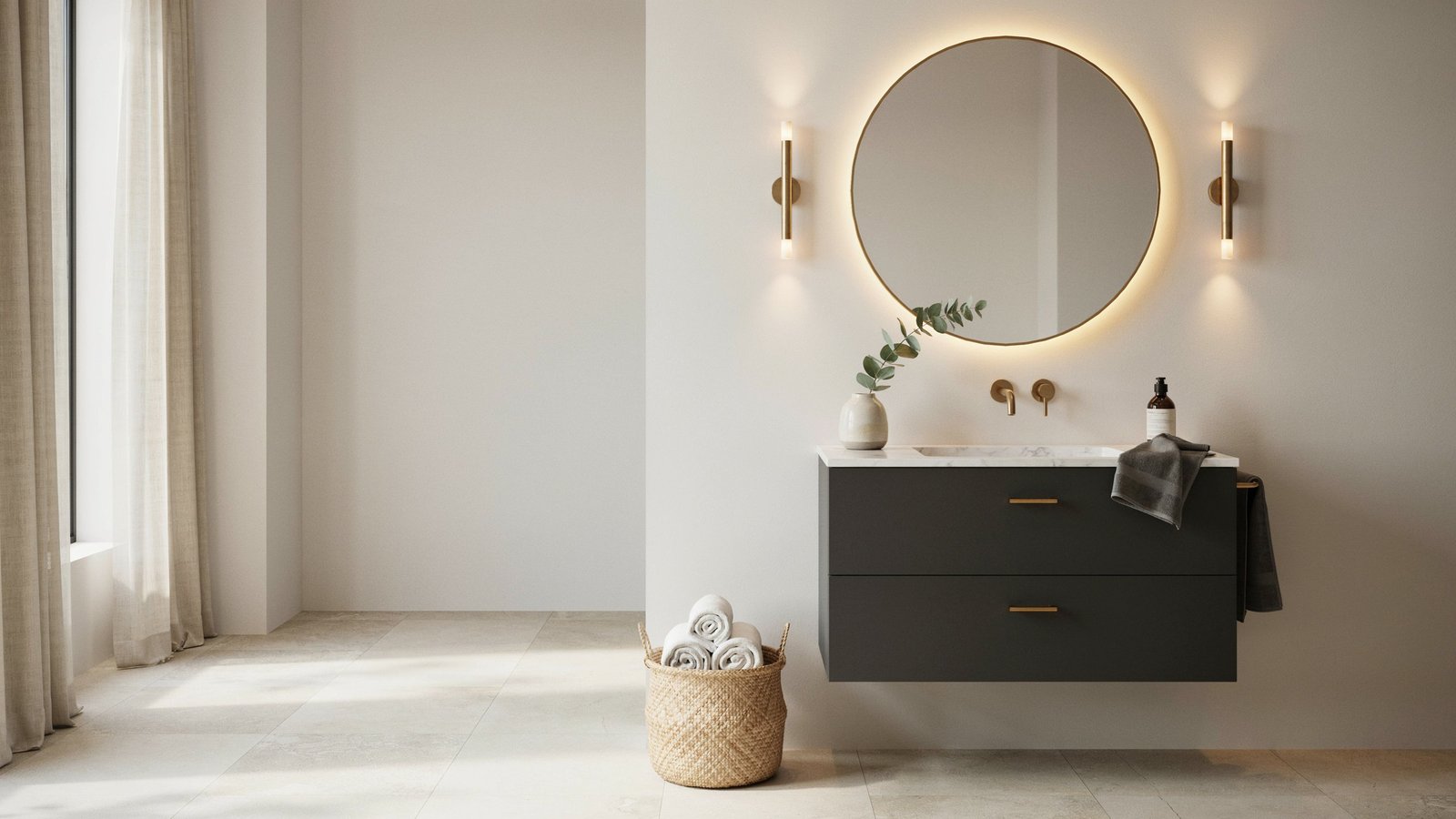
A black vanity gives a bathroom instant structure, and it works with almost every design style you can think of — from farmhouse to modern minimalist. Among black vanity bathroom ideas, this piece consistently ranks as one of the highest-impact, lowest-effort upgrades because it does so much visual work for so little square footage.
The biggest advantage is contrast. A black bathroom vanity anchors the room the way a piece of furniture anchors a living room — it gives your eye a place to land first. Pair it with a white quartz countertop or a Carrara marble top, and you get a clean countertop contrast that reads as expensive without an expensive price tag. This is why a modern black bathroom vanity has become the go-to choice for homeowners doing a mid-range remodel: the contrast alone can make a builder-grade bathroom look custom. Layout flexibility adds to this too — some homeowners even go with two separate vanities placed kitty-corner instead of one long double vanity, which works well in oddly shaped primary bathrooms while still keeping that same black-on-black contrast running through the room.
Black also hides what other colors can’t. Water spots, toothpaste splatter, and everyday grime show up fast on white or light wood cabinetry, but on a matte black vanity, most of that simply disappears between cleanings. This is a real, practical win for busy households — a family bathroom used by kids every morning genuinely looks cleaner, longer, with black rather than white.
Style flexibility is another underrated benefit. A furniture-style black vanity with brass or brushed nickel hardware leans traditional, while the same cabinet in matte black with slim black vanity hardware finishes feels distinctly contemporary. Because black is a neutral, not a color trend, it pairs easily with navy or emerald walls, warm wood tones, or stark white subway tile — you’re not locked into one look for the next ten years.
Finally, black vanities scale well. A black single vanity works beautifully in a small guest bath, while a black double vanity brings a serious, spa-like statement to a primary bathroom. Either way, it functions as a statement vanity — the one piece that sets the tone for tile, lighting, and hardware choices throughout the room.
If you’re deciding between a dark vanity and a lighter one for a small bathroom, it’s worth comparing how each affects the sense of space — a topic worth its own detailed look before you commit.
Cons of a Black Bathroom Vanity
The main drawbacks of a black bathroom vanity are visible water spots, constant dust, and a darker feel in small bathrooms. These aren’t dealbreakers, but they’re worth knowing before you commit, since they affect daily upkeep more than they affect the design itself.
The biggest complaint homeowners report is surface maintenance. A matte black vanity shows hard-water spots and toothpaste splatter almost immediately — a single unwiped drop of water near the faucet can leave a visible ring within minutes on a humid morning. This is the flip side of the “hides grime” advantage: black hides general dirt well but exposes anything wet or reflective. Glossy black finishes make this worse, since they highlight water spots and surface scratches the way a piano finish does, while a matte or satin finish softens the effect considerably.
Dust visibility is the second common issue. Because black has no pattern to camouflage particles, dust and hair show up clearly under any light — especially under-vanity LED lighting or a backlit mirror, both of which cast light across the cabinet surface and make every speck obvious. Bathrooms with high-CRI lighting or bright sconce lighting tend to expose this even more, so black vanity owners typically need to wipe the cabinet down two to three times a week rather than once.
In terms of space, a black vanity can create a space-reducing effect in a small bathroom. Dark colors visually shrink a room the way a dark rug shrinks a living room — a 5×8 foot bathroom with a black double vanity and no contrasting wall color can start to feel cramped rather than cozy. This is less of a problem with a black floating vanity, since the visible floor space underneath keeps the room feeling open, but a full-to-the-floor cabinet in the same finish will read heavier.
A few other trade-offs worth flagging:
- Fingerprints and smudges show more on black vanity hardware, especially matte black pulls, compared to brushed nickel or chrome.
- Heat and light absorption can make a black vanity feel slightly warmer to the touch in bathrooms with strong natural light.
- Resale perception varies — a moody bathroom with heavy black tones is a bold, tonal look that not every buyer wants, unlike a neutral white vanity with broader appeal.
- Solid hardwood vs. engineered wood matters here too — solid wood in black finish shows scratches as bare wood underneath, while engineered wood with a black veneer often hides them better.
If your bathroom is on the smaller side, it’s worth reading up on layout and lighting tricks that offset this space-reducing effect — that’s a natural next topic once you’ve decided black is still the right fit.
Best Materials and Finishes for a Black Bathroom Vanity
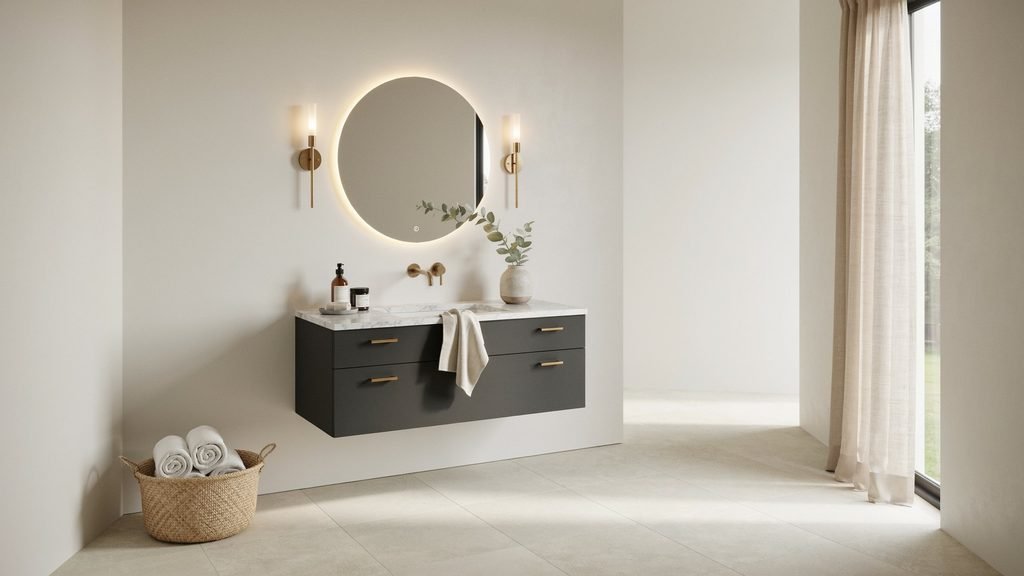
Solid wood and plywood-core cabinets hold up best against bathroom moisture, and they should be your starting point when choosing a black bathroom vanity. Material matters more than color here — the finish is what you see, but the core material is what determines whether that vanity still looks good in five years or starts swelling at the seams after one humid summer.
Bathrooms run 60–80% humidity during a hot shower, and cheap particleboard cabinets absorb that moisture at the seams, causing the black finish to bubble or peel within a year or two in daily-use bathrooms. Solid hardwood and quality plywood-core construction resist this far better, which is why most furniture-style black vanity pieces from reputable brands use one of the two rather than MDF. The same moisture logic applies just behind the vanity, too — pairing a solid-core cabinet with a proper bathroom vanity backsplash protects the wall from water splashing off the countertop and keeps the whole setup looking finished rather than makeshift.
Cabinet Material Options
- Solid hardwood – most durable, holds paint and stain well, but costs more and can still expand slightly with humidity swings.
- Engineered wood (plywood-core) – the practical middle ground; stable in moisture, holds black finishes evenly, and is what most mid-range black vanities are built from.
- MDF with black lacquer – smooth, budget-friendly look, but weakest against water exposure near sink splash zones.
Finish Types: Matte, Glossy, and Satin
The finish changes both the look and the maintenance load, not just the style. A matte black vanity hides fingerprints and everyday dust better than a glossy one, but a glossy finish reflects light and makes a small bathroom feel brighter. Satin sits in between and is often the easiest to live with day to day.
- Matte finish – hides smudges and water spots best; shows scuffs from hard contact more easily.
- Glossy finish – bounces light well, pairs nicely with brushed nickel hardware, but shows every water spot and surface scratch.
- Satin finish – balanced sheen, forgiving of daily use, a common pick for a modern black bathroom vanity in high-traffic family bathrooms.
Countertop Pairings That Hold Up
The countertop takes more daily abuse than the cabinet itself, so material choice matters just as much here. A black vanity with white quartz countertop is the most popular pairing in the U.S. right now because quartz resists staining and doesn’t need sealing, unlike natural stone. A black vanity with marble countertop, especially Carrara marble or marble-look quartz, gives a more upscale, timeless look but needs periodic sealing to avoid etching from toothpaste or perfume.
Hardware Finish Considerations
Hardware finish should match the room’s overall tone rather than being picked in isolation. Brass and gold hardware against a black vanity creates strong countertop contrast and reads as more traditional or transitional, while brushed nickel or chrome feels cleaner and more contemporary. This is the classic gold vs. matte black hardware decision, and it usually comes down to whether the rest of your fixtures — faucet, mirror frame, light fixtures — lean warm or cool.
If you’re also choosing tile for the same bathroom, pairing decisions here connect directly to how large-format porcelain tile or zellige tile reads against a black vanity — a detail worth covering in its own dedicated section.
Best Countertop Ideas for a Black Vanity
White quartz and soft-veined marble are the safest countertop choices for a black vanity, since both create strong contrast without competing with the cabinet for attention. Once you’ve settled on a black bathroom vanity, the countertop is really the second-biggest design decision in the room — it either sharpens the contrast or flattens it, depending on the material and veining you pick.
The logic here is simple: black absorbs light, so the countertop above it needs to reflect light back into the room. A pure white quartz countertop does this reliably — it’s non-porous, needs no sealing, and resists the toothpaste and makeup stains that build up on a bathroom counter within weeks of daily use. This is why a black vanity with white quartz countertop pairing shows up so often in real renovation photos across the U.S.; it’s practical as much as it is good-looking.
Marble brings a different kind of contrast — one with movement instead of flatness. A black vanity with marble countertop, especially Carrara marble with soft grey veining, adds a subtle, high-end texture that pure white quartz can’t replicate. The trade-off is maintenance: marble is porous and needs sealing roughly once a year to resist etching from acidic products like perfume or mouthwash. If you want the marble look without that upkeep, marble-look quartz gives you the same veining pattern with the stain resistance of engineered stone.
For homeowners who want to lean into a darker, moodier bathroom rather than fight the black vanity with contrast, a dark stone countertop is worth considering. A honed black granite or dark quartz creates a tonal look — vanity and counter reading almost as one piece — which works well in bathrooms already using navy or emerald walls or dim, layered lighting. This is a more advanced design choice, though, since too much dark stone countertop can increase visual weight and make a small bathroom feel closed in.
A few countertop options worth comparing:
- Pure white quartz – highest contrast, zero maintenance, most budget-friendly of the group.
- Carrara marble – classic veining, elevated look, needs yearly sealing.
- Marble-look quartz – marble aesthetic with quartz durability, a popular middle-ground pick.
- Dark stone countertop (granite or quartz) – best for a moody, tonal bathroom, but adds visual weight in tight spaces.
- White quartz with subtle grey veining – a softer alternative for those who want contrast without stark white.
One detail people overlook: the undermount sink and edge profile matter as much as the slab color. A black vanity with undermount sink paired with a simple straight or eased edge keeps the look clean, while an ornate edge on a busy marble pattern can start to feel cluttered.
This countertop decision also ties directly into hardware and faucet coordination — which finish you pick for the sink and faucet should echo the same warm or cool tone running through the counter and cabinet, a pairing detailed further in the hardware section of this guide.
Hardware Finishes for a Black Vanity: Gold, Matte Black, and Chrome
Brass hardware warms up a room, matte black keeps it modern, and nickel or chrome gives it a crisp, clean edge — the right choice depends on the mood you want, not just what’s trending. On a black bathroom vanity, hardware finish carries more visual weight than people expect, since it’s the one detail your hand actually touches every day and your eye catches every time you walk in.
The most common decision homeowners face is gold vs. matte black hardware. Brass or gold pulls against a black vanity create instant countertop contrast and lean traditional or transitional — think a furniture-style black vanity with brushed brass knobs, which is one of the most requested combinations in U.S. bathroom remodels right now. Matte black hardware, on the other hand, disappears into the cabinet almost completely, giving a sleeker, more minimal look that suits a modern black bathroom vanity with clean lines and minimal ornamentation.
Chrome and brushed nickel sit in a different lane entirely. A black vanity with brushed nickel hardware feels cooler and more neutral than brass, and it pairs especially well with white quartz countertops and chrome plumbing fixtures already common in most American homes — meaning you often don’t need to replace the faucet or shower fixtures to match. Polished chrome goes a step further, adding a bright, reflective pop that works well in a smaller bathroom needing extra light bounce.
A few practical points worth considering before you pick:
- Brass and gold hardware – warmest tone, highest contrast against black, best suited to traditional or transitional bathrooms.
- Matte black hardware – most seamless look, near-invisible against the cabinet, ideal for minimalist and modern styles.
- Brushed nickel – balanced, low-maintenance, hides fingerprints better than polished finishes.
- Polished chrome – brightest and most reflective, good for smaller bathrooms that need more visible light.
- Mixed metals – increasingly common in 2026 designs, such as black hardware with a brass faucet, but works best when one metal clearly leads.
One real-world detail worth noting: matte finishes, whether matte black or brushed nickel, hide fingerprints and water spots far better than anything polished. A family bathroom used by kids multiple times a day will show noticeably fewer smudges on matte black vanity hardware than on polished brass or chrome — a small factor, but one that affects how often you’re wiping down cabinets. Design guides on matching hardware finishes generally back this up, noting that brushed nickel and polished chrome tend to read as cool and precise, while matte black carries a strong architectural presence despite being more neutral than it first appears, which is part of why it pairs so cleanly with a black vanity’s own tone. infinite-bath
Hardware choice should never be made in isolation, either. It needs to echo the faucet finish, mirror frame, and light fixtures in the room for proper hardware and faucet coordination — a topic that deserves its own deeper breakdown once the vanity and countertop decisions are locked in.
Tile and Wall Color Ideas That Pair With a Black Vanity
Light tile and soft wall colors are what keep a black vanity from feeling too heavy in a bathroom, balancing out its visual weight so the room still feels open and inviting. Black vanity tile pairing is one of the most overlooked parts of the design process — people spend weeks choosing the vanity and countertop, then default to whatever tile is on sale, which often works against the effect they were going for.
The safest starting point is large-format porcelain tile in white, cream, or light grey. Bigger tiles mean fewer grout lines, which keeps the floor and walls feeling clean and uncluttered next to a bold, dark cabinet. A 12×24 inch porcelain tile, for example, visually stretches a small bathroom far more than a 4×4 inch tile would, which directly offsets the space-reducing effect that black vanities can create in tighter rooms. This pairing is especially common in modern black bathroom vanity setups where the goal is a crisp, contemporary look rather than a busy one.
For a more textured, artisanal feel, zellige tile has become a go-to choice in American bathroom remodels. Its slightly irregular, handmade surface catches light unevenly, which adds warmth and depth that a flat black vanity on its own can’t provide. A soft white or pale blue zellige tile backsplash behind a black single vanity creates a layered, collected look without introducing another dark tone into the room.
Wall color plays an equally important role. Two directions work well here, depending on the mood you’re after:
- Soft, light walls – warm white, soft greige, or pale blue keep the black vanity as the clear focal point and prevent the room from feeling closed in — the classic countertop contrast approach extended to the walls.
- Deep, saturated walls – navy or emerald walls lean into a moody bathroom aesthetic, creating a tonal look where the vanity and walls work together rather than contrasting, best suited to larger bathrooms with good natural or layered lighting.
A practical detail worth knowing: darker wall colors absorb more light, so if you go the navy-or-emerald route, you’ll likely need to add sconce lighting or a backlit mirror to keep the room from feeling dim — something budget-conscious remodels sometimes skip and later regret.
Texture and material mixing matters just as much as color. Pairing a matte black vanity with glossy subway tile, or a textured zellige tile with a smooth quartz counter, keeps the eye moving instead of flattening the whole room into one finish. This is a transitional style trick used often by designers to make a single bold piece, like a statement vanity, feel intentional rather than isolated.
This naturally leads into lighting choices, since the same warm or cool tone decisions made with tile and wall color need to carry through to fixtures — a subject worth its own detailed section right after this one.
How to Mix Textures and Materials With a Black Vanity
Wood, stone, and glass are what keep a black vanity from looking flat, giving the surface enough texture and material mixing to feel layered instead of like one solid block of color. A black bathroom vanity is a strong, matte surface by nature, and without contrast in texture, even a well-designed bathroom can end up looking like a single dark shape rather than a considered room.
The core idea is that black reflects almost no light, so everything placed near it needs to bring some kind of visual interest — grain, shine, or pattern — to keep the eye engaged. A bathroom with a matte black vanity, a flat white wall, and plain white tile can end up looking oddly two-dimensional, even though every individual choice was reasonable on its own.
Wood Accents
Introducing wood is one of the simplest fixes. A white oak mirror frame above a black vanity immediately softens the hard edge of the cabinet and adds warmth without competing with it. Open wood shelving or a wood stool nearby does the same job at a smaller scale.
- Pair black with light or medium wood tones (white oak, ash) rather than dark wood, which can flatten the contrast instead of building it.
- Use wood in smaller doses — a mirror frame, a shelf, a stool — rather than a full wood wall, which can overwhelm the black vanity’s presence.
Stone Elements
Stone brings pattern and depth in a way flat paint never can. A black vanity with marble countertop already does part of this job, but extending stone into the shower wall or floor, such as large-format porcelain tile with subtle veining, ties the whole room together. Even a small stone soap dish or tray on the counter adds texture at eye level, where it’s noticed most.
- Carry the countertop’s stone pattern into one more surface, like the shower niche, so the material feels intentional rather than isolated.
- Avoid mixing more than two distinct stone patterns in one small bathroom, since it can compete with the black vanity for attention.
Glass and Reflective Surfaces
Glass is the easiest way to add shine without adding color. A backlit mirror above the vanity, a glass shower door, or simple glass canister jars on the counter all bounce light back into the room, offsetting the light-absorbing nature of a matte black vanity.
- A frameless glass shower door keeps sightlines open, which helps in bathrooms already dealing with the space-reducing effect of a dark vanity.
- Metallic or glass light fixtures paired with layered lighting add sparkle without introducing another solid color into the room.
One real-world example: a bathroom with a black floating vanity, a Carrara marble backsplash, a white oak mirror frame, and a simple glass shower door uses four different materials but only two colors — and that restraint is exactly what keeps a tonal, moody bathroom from feeling busy or cluttered.
This texture-and-material approach connects directly to lighting placement, since where you position sconce lighting or under-vanity LED lighting determines how much of that texture actually gets seen — a natural next section to cover in more depth.
How to Light a Black Vanity So It Doesn’t Look Flat
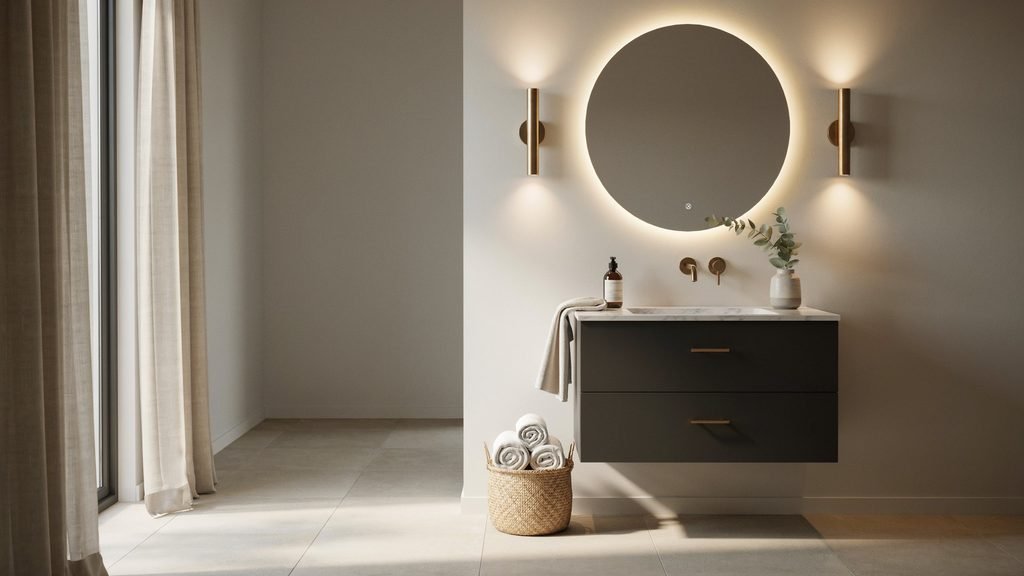
Sconces placed on either side of the mirror, combined with warm layered lighting, work best for keeping a black vanity from looking flat and shadowed. Black vanity lighting is one of the most technical parts of this whole design, because unlike white cabinetry, black absorbs light instead of bouncing it — which means the wrong setup can make an otherwise beautiful vanity disappear into shadow by evening.
The core problem with a single overhead light is uneven shadowing. A ceiling fixture positioned directly above the mirror casts light downward, creating shadows under the eyes and under the vanity’s edges — a common complaint in older bathroom layouts. This is why layered lighting, rather than one strong source, is the standard recommendation: combine ambient ceiling light, vertical task light at the mirror, and accent light near the cabinet base.
Sconce Placement
Sconce lighting mounted at eye level on either side of the mirror, roughly 60 to 65 inches from the floor, gives even, shadow-free light across the face and across the vanity surface. This single change solves most of the flat, dim look people associate with a matte black vanity.
- Space wall sconces about 28–36 inches apart, centered on the mirror, for balanced coverage.
- If space doesn’t allow side sconces, a backlit mirror is a strong second option, since it lights the face evenly without extra wall fixtures.
Color Temperature
Getting the color temperature right matters as much as placement. Warm light in the 2700K–3000K range flatters black cabinetry and skin tone alike, while cooler, bluish light (4000K and above) tends to make a black vanity look cold and almost grey rather than rich and matte.
- Stick to 2700K–3000K for vanity and sconce lighting in most residential bathrooms.
- Reserve high-CRI lighting (90+) for the vanity area specifically, since accurate color rendering matters most where people apply makeup or check grooming details.
Accent and Under-Vanity Lighting
For a black floating vanity, under-vanity LED lighting adds a soft glow beneath the cabinet that makes it appear to hover, while also making the black finish look intentional and dimensional rather than heavy. This is a detail seen often in modern black bathroom vanity installs, since the light strip breaks up what would otherwise be one uninterrupted dark mass from floor to countertop.
- LED strips under a floating vanity should sit slightly recessed so the light source itself stays hidden, showing only the glow.
- Keep under-vanity lighting on a separate switch or dimmer, since it works best as ambient night lighting rather than full task lighting.
A real-world example: a black double vanity lit only by a single ceiling can light will often look muddy and undefined by 7 p.m., while the same vanity with side sconces, a 3000K warm light, and a thin LED strip underneath reads as bright, dimensional, and genuinely more expensive — without changing a single material.
Getting this lighting plan right also depends on where the wall blocking and plumbing rough-in were placed during construction, since sconces and outlets need to land in the right spots before drywall goes up — a planning detail worth covering separately for anyone starting a full remodel rather than a simple swap.
Single vs Double Black Vanity: Which Size Works Best?
A 48-inch black single vanity is enough for one person, while two people sharing a bathroom every morning should look at 60 inches or wider for a black double vanity. The right choice comes down to daily routine, not just room size.
A single vanity works well in guest baths, powder rooms, or any bathroom used by one person at a time — a 36 to 48-inch black floating vanity keeps a small bathroom feeling open while still giving enough counter space for daily essentials. If you’re still weighing what counts as a single vs. a full vanity setup, it helps to start with what a vanity actually is and what it needs to include beyond just a sink and cabinet. Beyond that, once two adults are getting ready at the same time, a single sink becomes a real bottleneck, which is where a double vanity earns its extra footprint.
A black double vanity, typically 60 to 72 inches, gives each person their own sink and counter zone, cutting down morning traffic jams in shared primary bathrooms. The trade-off is space: a double vanity needs at least 60 inches of wall width to avoid feeling cramped, so it’s not the right call for a small bathroom just because it looks better in photos.
A quick way to decide:
- Single vanity (30–48 inches): best for one user, guest baths, small bathrooms.
- Double vanity (60–72+ inches): best for two daily users, primary bathrooms with adequate wall space.
Room size and layout matter just as much as vanity size here, especially when it comes to fitting a double vanity without shrinking the room visually — a detail worth exploring further alongside small-bathroom design tips.
Black Floating Vanity Ideas for Small Bathrooms
A floating vanity leaves the floor visible underneath it, which is exactly why a small bathroom feels more open with one installed. This isn’t just a design opinion — exposing floor space genuinely changes how a room reads, since elevating cabinetry off the floor reveals the flooring underneath and immediately changes the spatial perception of the room.
For actual sizing, most compact bathrooms do best in the 24 to 36-inch range. Narrow or condo-style layouts typically work with vanities 18 to 24 inches wide and 18 to 19.5 inches deep, while standard small bathrooms usually call for 24 to 30 inches, and slightly larger small bathrooms can handle 30 to 36 inches when extra storage matters. A common mistake is sizing up simply because a bigger vanity looks better in photos — even a couple of extra inches in width, or extra depth eating into the walkway, can make a small bathroom feel tighter rather than more open.
Clearance matters just as much as the vanity’s own footprint. At least 30 inches of open floor space in front of the vanity is recommended so drawers and cabinet doors can open freely, and this is one reason a black floating vanity works so well in tight layouts — the exposed floor beneath it visually absorbs part of that clearance requirement instead of feeling like dead space.
Real-world example: a 24-inch matte black floating vanity with a single ceramic sink is a common fit for a powder room or condo bathroom, giving enough counter space for daily essentials while keeping the footprint minimal.
A few practical sizing notes:
- 24 inches – best for powder rooms and very tight condo bathrooms; single-user only.
- 30 inches – the balanced middle option for most small full bathrooms.
- 36 inches – upper limit for a small bathroom if you want more drawer storage without crowding the room.
- Depth – keep it under 19–20 inches in tight layouts; depth affects walkway space more than width does.
If accessibility is a factor, keep in mind that ADA-compliant vanities generally stay no higher than 34 inches, and floating vanities with at least 27 inches of knee clearance underneath allow wheelchair access — a detail worth checking against local building codes before finalizing wall blocking and plumbing rough-in.
Conclusion
A black vanity isn’t just a color choice — it’s a decision about material, lighting, and how much upkeep you’re genuinely willing to do. Get the countertop, hardware, and lighting to work together, and even a small bathroom can feel intentional rather than crowded. The best black bathroom vanity ideas aren’t the boldest ones; they’re the ones planned around how you actually live.
So before you commit, ask yourself: is this vanity solving a real problem in your bathroom, or just chasing a trend?
FAQs
Is a black bathroom vanity a good idea?
Yes, for most bathrooms. A black vanity adds strong contrast, hides everyday grime well, and works with almost any style — the main trade-off is that water spots and dust show up faster than on lighter cabinets.
What color vanity is in style?
Black, warm wood tones, and soft green or navy are leading right now, with black remaining the top pick for a modern, high-contrast look in 2026 remodels.
What are the bathroom vanity trends for 2026?
Matte black and floating vanities, warm brass or unlacquered hardware, marble-look quartz countertops, and layered lighting with backlit mirrors are the standout trends this year.
What is the best color for a dark bathroom?
Deep charcoal, matte black, or navy work best in a dark-themed bathroom, especially when paired with warm lighting and a lighter countertop to keep the room from feeling closed in.
What colors complement a black bathroom?
White, warm greige, soft cream, and natural wood tones balance a black vanity best; brass or gold hardware adds warmth, while navy or emerald walls deepen the moody look.
What color not to paint a bathroom?
Avoid cool, flat greys or stark blue-whites with a black vanity — they can make the room feel sterile and cold instead of warm or contrasted.
How to style a bathroom with a black vanity?
Pair it with a light countertop, warm layered lighting, a mix of wood or stone texture, and hardware that matches your faucet finish so the whole room feels coordinated rather than one flat block of color.
What color makes black pop the most?
Crisp white creates the strongest contrast, though warm cream, soft brass tones, and natural wood also make a black vanity stand out without feeling stark.
About the Author
Bilal Khan
Bilal writes about home and bathroom design, with a particular interest in vanities, materials, and finishes. He enjoys researching practical, real-world details — from material durability to lighting and layout — and turning them into clear, useful guides for homeowners planning a remodel.
Have questions or feedback on this guide? Feel free to share your thoughts in the comments below.
Pingback: Standard Bathroom Vanity Depth: Sizes, Types & Clearances
Pingback: Stone Concepts Misterio Calacatta Quartz: Complete Guide
Pingback: Bedroom Sets With Vanity Dresser: Complete Guide